
The base rate is your starting point, not your ending point
The number at the center of every prediction market transaction — the price — represents a probability. When you buy YES at 0.65, you’re paying 65 cents for the right to receive one dollar if the event resolves YES. If you do this enough times at prices that are below the true probability of the outcome, you make money over time. If you do it at prices that are above the true probability, you lose money over time.
This sounds simple. In practice, most retail prediction market traders don’t actually think this way, and the gap between how they think and how the math works is where most losses originate.
For any market you’re considering trading, there’s a relevant base rate: how often have comparable events historically resolved in the direction you’re considering? Before you have any specific information about the current event, this base rate is your prior probability estimate.
New traders often skip this step entirely. They come in with an opinion about the current event — based on news, intuition, or recent attention to the topic — and work backward to a number. This produces systematically biased estimates because it anchors on current information rather than starting from historical rates and updating from there.
The correct process: find the base rate for comparable events, then update it based on specific information that’s actually different about this instance. The update should be proportional to how strongly the new information should shift probabilities — not proportional to how interesting or emotionally resonant the news is.
Overconfidence is the most common and expensive bias
Research on forecasting consistently shows that people are overconfident in their probability estimates, especially on questions they feel informed about. A trader who says “I’m 80% sure this team wins” typically means something closer to “this team probably wins and I’m confident about it” — not an actual calibrated 80% that would mean they’re right four times out of five on similar-feeling situations.
The practical consequence: traders who feel confident about a market tend to bet too much on it and accept prices that are too low (on YES) or too high (on NO). They’re paying for confidence they don’t actually have as measured by their historical accuracy.
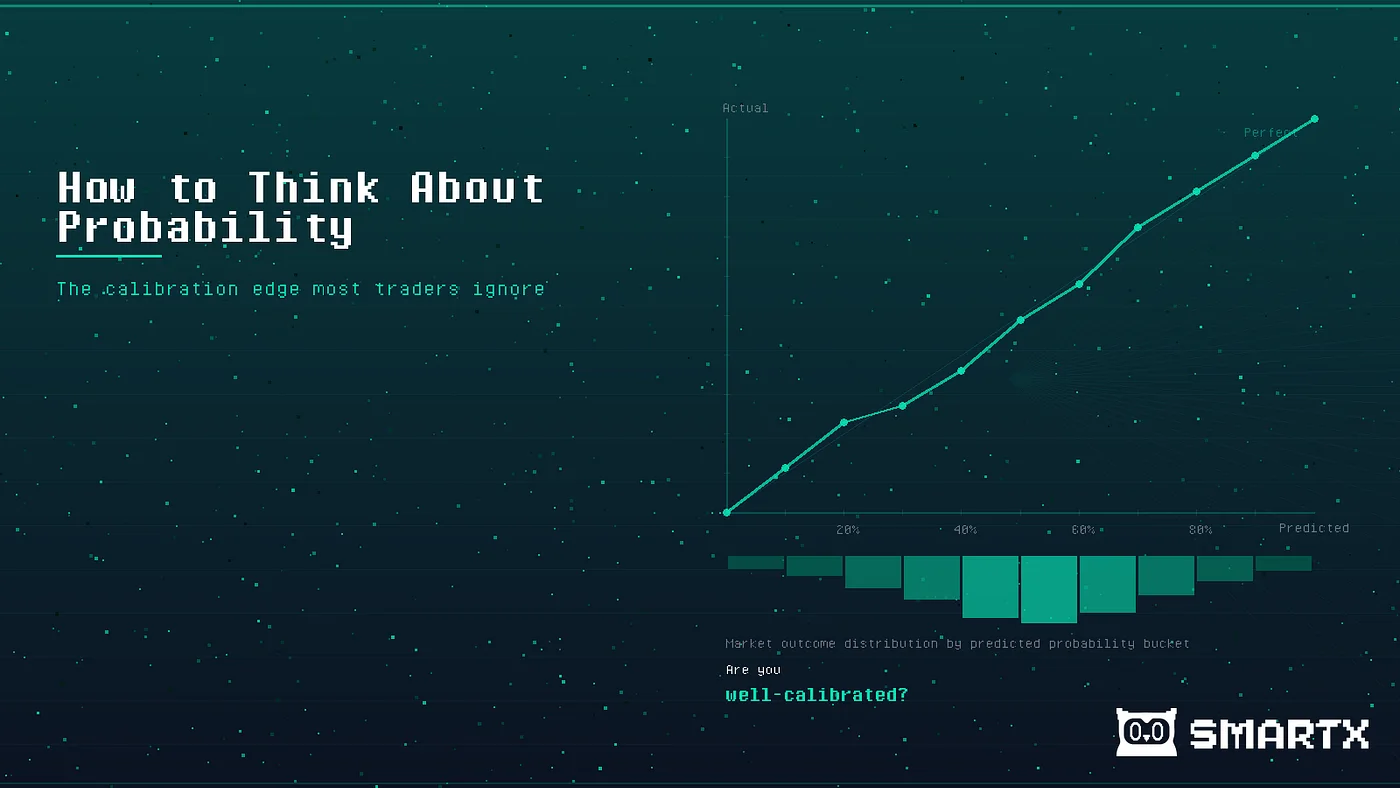
Calibration — being right as often as your confidence level implies — is learnable. It requires keeping records of your probability estimates and comparing them to outcomes. If you say you’re 75% sure about something 100 times, you should be right about 75 of those times. If you’re actually right 60 times, you’re overconfident at the 75% level and should adjust downward.
Market efficiency varies dramatically by category
Not all Polymarket markets are equally hard to beat. High-profile markets with significant volume — major election outcomes, major sports championships — incorporate large amounts of information from sophisticated participants. These markets are hard to beat because you’re competing with professional forecasters, quantitative models, and traders who specialize exclusively in these events.
Lower-visibility markets, especially those in niche categories or with shorter resolution windows, are often less efficiently priced. Fewer participants are actively updating the probability as new information arrives, which means the market price can lag real-world probability changes.
The practical implication: if you have genuine expertise in a category that doesn’t attract a lot of sophisticated volume, your probability estimates are more likely to be better than the market’s. In categories dominated by professional forecasters and large-volume traders, you need a specific informational or analytical advantage to beat the market price, not just general knowledge.
The Kelly criterion — and why you should bet a fraction of it
The Kelly criterion tells you how much of your bankroll to bet on a positive expected value opportunity. The formula is (edge / odds), where edge is the difference between your estimated probability and the market price. If you think an event is 70% likely and the market prices it at 55%, your edge is 15 points.
Kelly is theoretically optimal for long-run wealth maximization, but it produces bet sizes that feel uncomfortable and can cause significant volatility in your bankroll. Most serious prediction market traders use half-Kelly or quarter-Kelly — betting half or a quarter of the Kelly-recommended size. This reduces expected long-run return slightly but dramatically reduces variance, which matters for staying solvent through normal losing runs.
The key insight from Kelly: your bet size should scale with both your estimated edge and your confidence in that estimate. Betting the same size on every trade regardless of estimated edge is leaving money on the table when you have a big edge and taking excessive risk when you have a small one.
Building calibration over time
SmartX builds a running record of your prediction market decisions through Trade Memory — capturing not just the trade itself but the market context and what you expected. Over time, this record becomes the data set you need to evaluate your own calibration: are you right as often as you think you are, and in which categories is your probability estimation actually better than the market?
This feedback loop is what separates traders who actually improve their probability reasoning over time from those who accumulate experience without the analytical structure to learn from it.
Better probability thinking is one of the few sustainable edges available to retail prediction market traders. Most of the others — speed, capital, information access — favor institutions and professionals. Calibration is available to anyone willing to track their decisions carefully.
LIVE ON POLYMARKET