
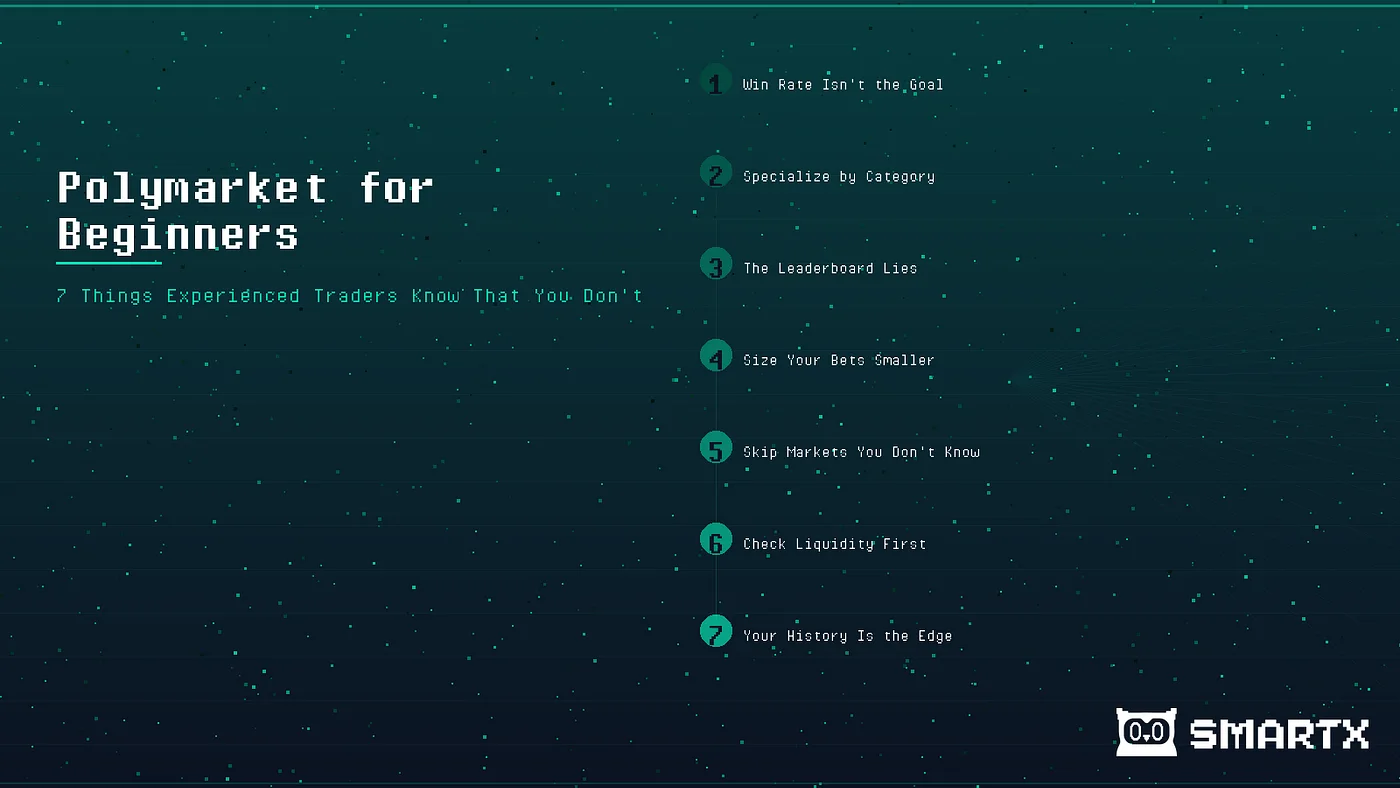
1. Win rate is almost always the wrong metric to optimize
Most beginners on Polymarket make the same set of mistakes. Not because they’re uninformed — most Polymarket beginners have done significant research before placing their first bet. They make the same mistakes because the things that actually matter on prediction markets aren’t obvious, and the platform itself doesn’t tell you.
This isn’t a guide to prediction market theory or probability math. It’s the practical things that separate traders who improve over time from those who stay stuck at the same results. Some of them are counterintuitive. All of them took experienced traders real money to figure out.
New traders fixate on winning more often. Experienced traders understand that what matters is the relationship between your win rate and the implied probability of what you’re betting on.
Winning 55% of the time sounds good. But if you’re consistently betting on outcomes priced at 60% or higher, you’re losing money. Winning 45% of the time sounds bad. But if you’re betting on outcomes priced at 30%, you’re printing money.
The number that actually matters is whether you’re getting better prices than the market’s probability estimates. Win rate is just one input into that calculation, not the target.
2. Category specialization matters more than most people realize
The traders with the most consistent results on Polymarket tend to dominate in one or two categories. The best sports bettors are systematically better at sports markets than at political ones. The best political market traders often underperform in crypto or economic markets.
This isn’t surprising when you think about it: developing a genuine edge requires deep knowledge of a specific information environment. Sports have injury reports, team performance data, and historical patterns. Political markets have polling data, historical base rates, and news cycles. These require completely different knowledge bases.
Most beginners spread across categories before they’ve built a real edge in any of them. Concentrating in one category and building genuine domain expertise there typically outperforms spreading thin.
3. The leaderboard doesn’t tell you what you think it tells you
The most common error beginners make when looking at the Polymarket leaderboard is assuming that the wallets at the top are winning the same way. They’re not.
The #1 wallet in a given week might have made its money via thousands of automated small bets with a 50.3% win rate. The #5 wallet might have made 9 bets, won 6 of them, and sized each one at $30,000. These are completely opposite strategies that happen to produce similar profit numbers. If you try to copy either one without understanding the strategy behind it, you’ll likely lose money.
4. Position sizing is where most money is actually lost
Most beginners lose money not because they’re wrong about outcomes but because they bet too much on uncertain positions. A trade where your analysis suggests 55% probability of a YES that’s priced at 45% is a good bet — but if you put 30% of your capital on it, one losing streak will end your session before the edge can compound.
Kelly criterion is the formal framework, but the practical version is: bet a fraction of what feels right, especially early. Most traders who blow up on prediction markets do so because of bet sizing, not because of bad analysis.
5. The markets you don’t trade matter as much as the ones you do
Experienced traders are disciplined about which markets they skip. Beginners tend to find markets interesting and bet on things they have opinions about. These aren’t the same thing.
Having an opinion about who will win an election is not the same as having analytical edge in that prediction market. The market has already incorporated public information, expert forecasts, and polling data. Your opinion only matters if it’s based on something the market hasn’t already priced in.
Skipping markets where you don’t have a specific informational or analytical edge is a position, and it’s often the right one.
6. Liquidity affects you more than you think
Many Polymarket markets have thin liquidity, especially outside of the most popular events. When you place a large bet in a thin market, you’re often moving the price against yourself.
This matters for entry and especially for exit. A position that looks profitable at the current market price might be significantly less profitable if you try to close it before resolution, because the only prices available to you are much worse.
Checking the order book depth before sizing a position is a basic practice that beginners skip and experienced traders never skip.
7. Your biggest edge is data you already have
Every trade you’ve placed on Polymarket is information about what works and what doesn’t for your specific approach. Most traders never systematically analyze this data. They have a general sense of which categories they’re better at, but they haven’t actually calculated their win rates by category and compared those rates to the implied probabilities of what they were betting on.
This analysis is where most of the available edge lives for retail prediction market traders. Not in better news aggregation or smarter market research — in understanding your own decision patterns well enough to know where to concentrate and where to avoid.
SmartX is built to automate this analysis. The Trade Memory system captures context behind every trade, the behavioral tagging identifies what type of trader each wallet is, and the recommendation engine surfaces opportunities based on your specific track record.
The shortest path from beginner to consistent is usually not finding better tips — it’s learning what your own history is telling you.
LIVE ON POLYMARKET