
What SmartX actually is
Most tools built around Polymarket fall into one of two categories: data dashboards that show you what’s happening, and leaderboards that show you who made money. Both are useful in the same limited way a scoreboard is useful — they tell you the result, not the game.
SmartX is built around a different question: not what happened, but what your specific trading history says about where your edge actually is. If you’ve heard the name but aren’t sure what it does or whether it’s relevant to how you trade, this is the straightforward breakdown.
SmartX is an AI trading terminal purpose-built for Polymarket. The core premise is that the most valuable signal for improving your prediction market performance is your own trading history — more useful than market-wide trends, more actionable than smart money leaderboards, and more specific than any generic signal service.
The terminal is built around two features. The first is Trade Memory: every trade you place through SmartX is recorded with full context — the market category, the entry timing, the signal or thesis behind the bet, and what outcome you expected. Over time, this builds a structured log of your decision-making process, not just your transactions.
The second is Personalized Recommendations: the terminal uses your Trade Memory to surface market opportunities that match your demonstrated strengths. If your win rate in sports markets is significantly higher than in political markets, SmartX surfaces more sports opportunities and fewer political ones — not because it hides information, but because it’s weighting what your own data says is actually useful to you.
Who it’s for
SmartX is built for active Polymarket traders who want to get better over time, not just trade more.
The most common profile is someone who’s been on Polymarket for at least a few months, has developed opinions about which markets they understand better than others, and is frustrated that there’s no systematic way to track whether those opinions are actually reflected in their results.
The tool is less useful for someone who’s completely new to prediction markets and hasn’t yet built up a base of trade history to learn from. It’s also less relevant for the highest-frequency market makers running automated execution at scale — that’s a different game that doesn’t depend on the kind of behavioral pattern analysis SmartX is designed for.
The smart money tracking layer
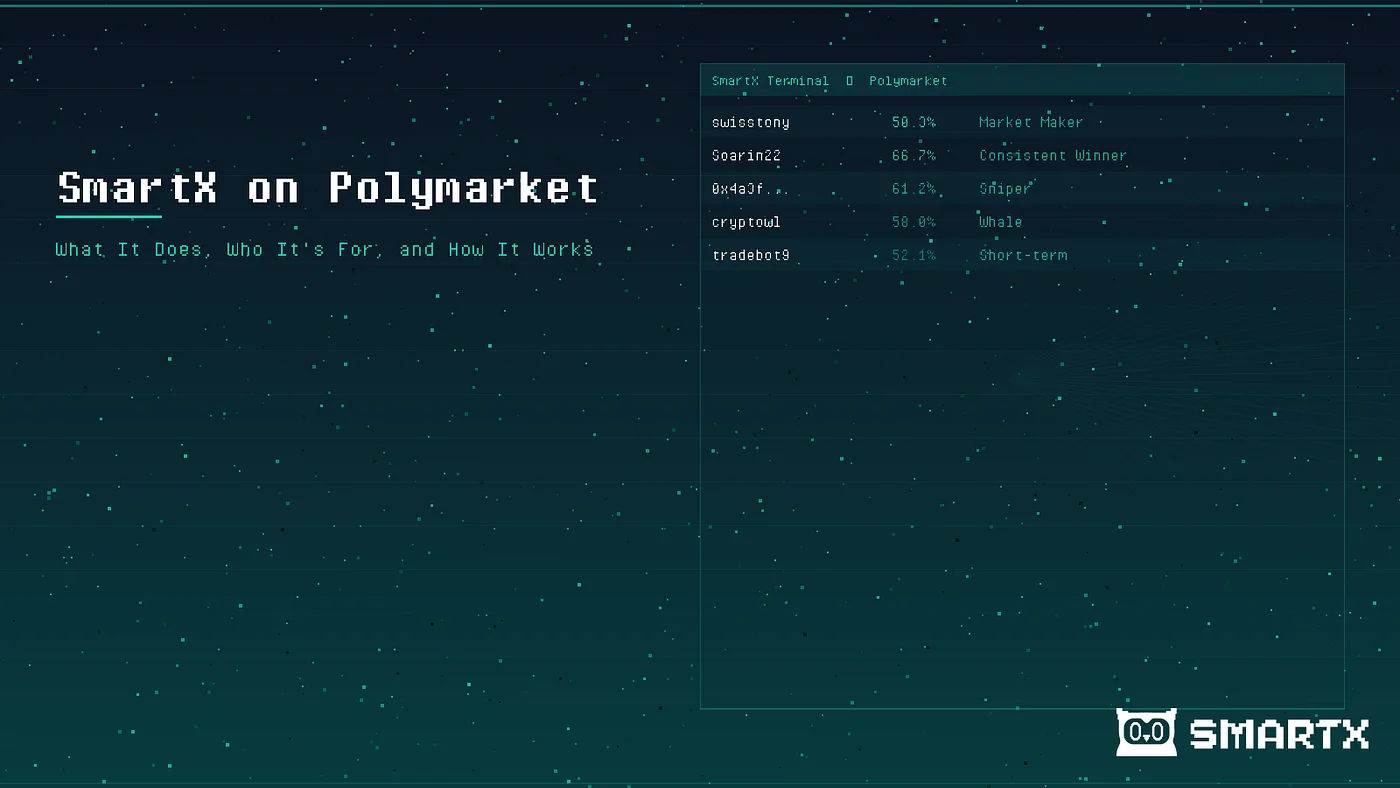
Beyond your own trading history, SmartX also provides wallet-level behavioral analysis for other Polymarket traders. Every wallet gets auto-tagged based on how it actually trades: Market Maker, Short-term, Consistent Winner, Whale, and which market categories it consistently wins in.
This matters because a plain leaderboard doesn’t distinguish between a wallet that made money via 8,000 automated micro-bets in sports markets and one that made money via 9 large conviction bets in political markets. These are completely different trading profiles, and which one is worth learning from depends entirely on what kind of trader you are.
The SmartX behavioral tags let you filter for wallets that are actually comparable to your own approach — then watch where they’re positioning before markets move.
What the setup looks like
The terminal connects to your Polymarket activity. Once connected, it begins building your Trade Memory from your existing trade history. Recommendations start broadly and get more specific as the system accumulates context about your trading patterns — which categories you perform in, what signals have historically preceded your best trades, where your record is weak.
This means the value compounds over time. Traders who use SmartX for six months have a meaningfully different experience than traders who just signed up, because the system has had more data to calibrate against.
What it doesn’t do
SmartX doesn’t give you information that isn’t already in Polymarket’s on-chain data. It doesn’t have inside information, doesn’t have access to private order flow, and doesn’t guarantee better results. What it provides is structure: a way to turn your own trading history and the behavioral patterns of other traders into something you can actually make decisions from.
It’s also not a copy-trading platform. The smart money signals are meant as research inputs, not as bets to follow. The traders worth tracking on Polymarket often have edge that’s specific to their execution speed, position sizing, or market category expertise — and that edge doesn’t automatically transfer to following their individual bets without the same context.
The actual question
The question SmartX is designed to answer is: given everything that’s happened in your Polymarket history, where should you be allocating attention and capital next week?
A leaderboard can’t answer that. A data dashboard can’t answer that. A wallet following tool can’t answer that either. Your own trading history, properly analyzed against your demonstrated win rates by category and signal type, can start to answer it.
That’s what the terminal does.
LIVE ON POLYMARKET