
The core problem SmartX is built to solve
If you’ve been on Polymarket for more than a few months, you’ve probably noticed that the platform itself doesn’t give you much to work with analytically. The market list, the order book, the basic leaderboard — these are the tools you get. For a trader who’s trying to improve systematically and understand what the best-performing wallets on the platform are actually doing, that’s not enough.
SmartX is the terminal built to fill that gap. This is a complete breakdown of what it does, how the main features work, and who gets the most value from using it.
Polymarket data is public and on-chain, which means in theory everything you’d want to know about any wallet is accessible. In practice, extracting useful information from raw on-chain data requires tools most traders don’t have — and even with tools, the analysis needed to understand what a trading pattern means takes significant time.
The result is that most traders make decisions based on the limited data the Polymarket interface surfaces directly: who’s up on the leaderboard, what markets have high volume, which direction the current price is moving. This information is real, but it’s a fraction of what’s available — and it’s the fraction that every participant sees simultaneously.
SmartX reads the on-chain data that most traders don’t have time to analyze and surfaces the behavioral signals that actually matter.
Trade Memory: capturing the context, not just the transaction
Most prediction market losses that traders review later don’t look obviously wrong after the fact — they looked reasonable at the time. The problem is that “at the time” disappears. Traders remember outcomes but lose the context: what they thought the probability was, why they sized the position the way they did, what signal they were acting on.
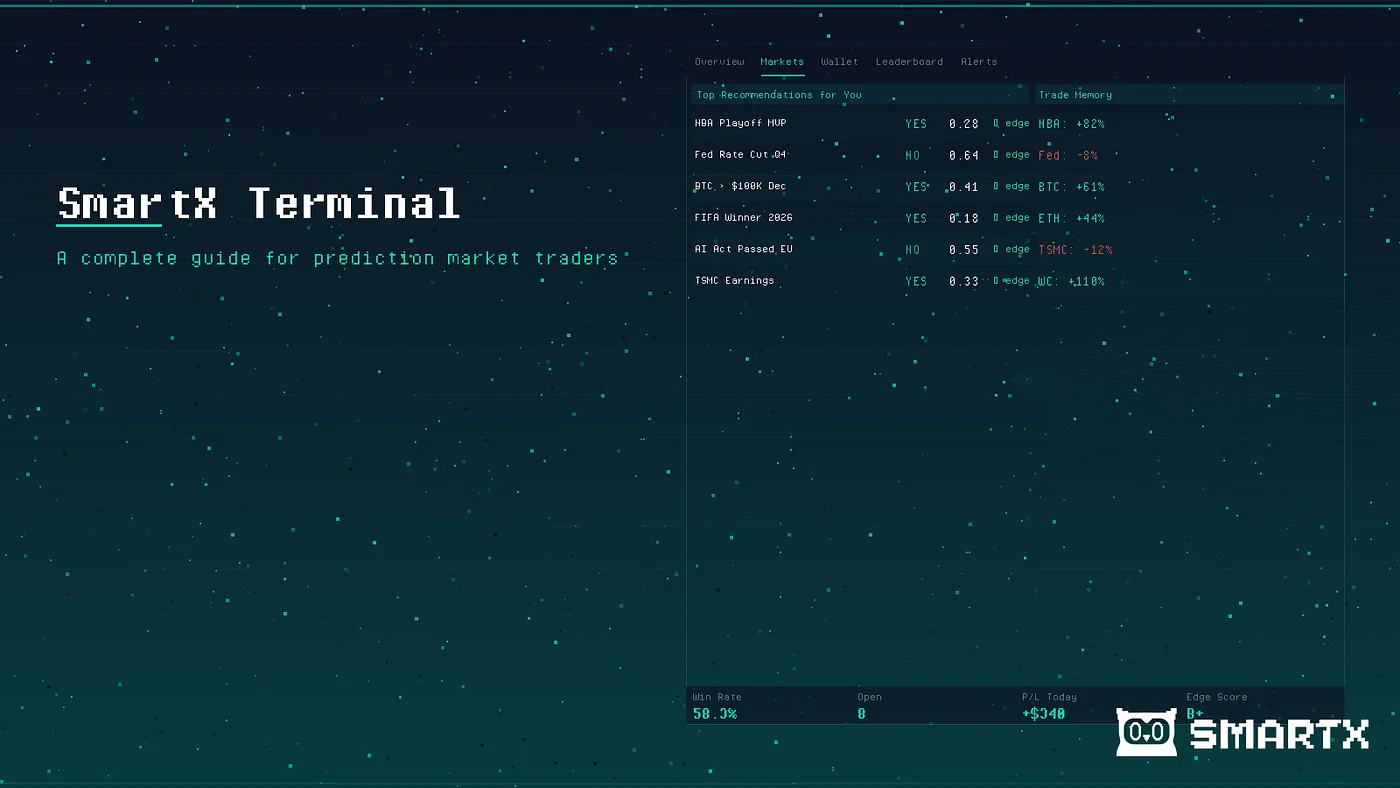
Trade Memory is the SmartX feature that captures this context automatically. When you trade through the terminal, the decision environment is recorded: the market category, the entry price, the position size relative to your portfolio, and the thesis or signal behind the bet. This data is stored in your persistent trading profile.
The value accumulates over time. After 50 trades with full context recorded, you have enough data to see patterns: which categories you perform in, which types of entry signals have been reliable, where your position sizing doesn’t match your actual conviction. After 200 trades, these patterns are statistically clear enough to act on.
Personalized Recommendations: your history as your signal
The Personalized Recommendation engine uses your Trade Memory to surface market opportunities that match your demonstrated edge — not markets that are interesting in general, but markets where your specific profile suggests you might have an advantage.
If your win rate in sports markets is substantially above your win rate in political markets, the recommendation engine surfaces more sports opportunities and down-weights political ones. If certain types of signal conditions have historically preceded your better trades, the system identifies similar conditions when they emerge.
This is fundamentally different from any generic signal or tip service. Generic signals are calibrated to the average trader. SmartX recommendations are calibrated to your specific history.
Wallet behavioral tagging: knowing what you’re looking at
The behavioral tagging system is how SmartX makes the smart money leaderboard readable. Every wallet on Polymarket is automatically categorized based on its actual trading behavior:
Market Maker — high frequency, thin margins, often near 50% win rate, trading structure rather than prediction.
Consistent Winner — above-average win rate over significant sample, suggesting genuine predictive edge.
Whale — large average position size, significant capital, moves markets when they enter.
Short-term — high flip rate, frequently exits positions before resolution, momentum-oriented.
Category Specialist — strong performance concentrated in specific market types (sports, political, crypto).
These tags let you filter wallets by behavior type rather than by raw PnL. A Market Maker wallet might have $4M in weekly profit and a 50.3% win rate — impressive numbers that become misleading if you try to copy individual bets. A Consistent Winner with a 65% win rate in political markets and a 15-trade average per week is a very different kind of wallet to study.
What’s coming: the full terminal
The behavioral tagging layer is live now. The full terminal — where you filter thousands of wallets by category focus and performance metrics, see what wallets matching your profile are currently positioning in, and get real-time signals when smart money moves into markets you watch — is in development.
The signal bot already gives you a preview of what this looks like in practice: real-time alerts when significant behavioral signals appear in Polymarket markets, filtered by the categories you care about.
Who benefits most
SmartX is most valuable for traders who are already active on Polymarket, have developed some preferences about which markets they understand better, and are looking for a systematic way to learn from their own history and calibrate against the best performers in their categories.
It’s less immediately useful for traders who are completely new to prediction markets and haven’t yet built up a meaningful trade history — though starting the Trade Memory log early means the data is there when you want to analyze it.
LIVE ON POLYMARKET