
Infrastructure changes the game
When people talk about Polymarket, they usually focus on the trading. The markets, the probabilities, the leaderboards. What gets less attention is the infrastructure — the fact that Polymarket is an on-chain prediction market, and what that actually means for traders.
This isn’t a technical detail. It’s a structural feature that changes the nature of the game in ways that matter practically.
What “on-chain” means in plain terms
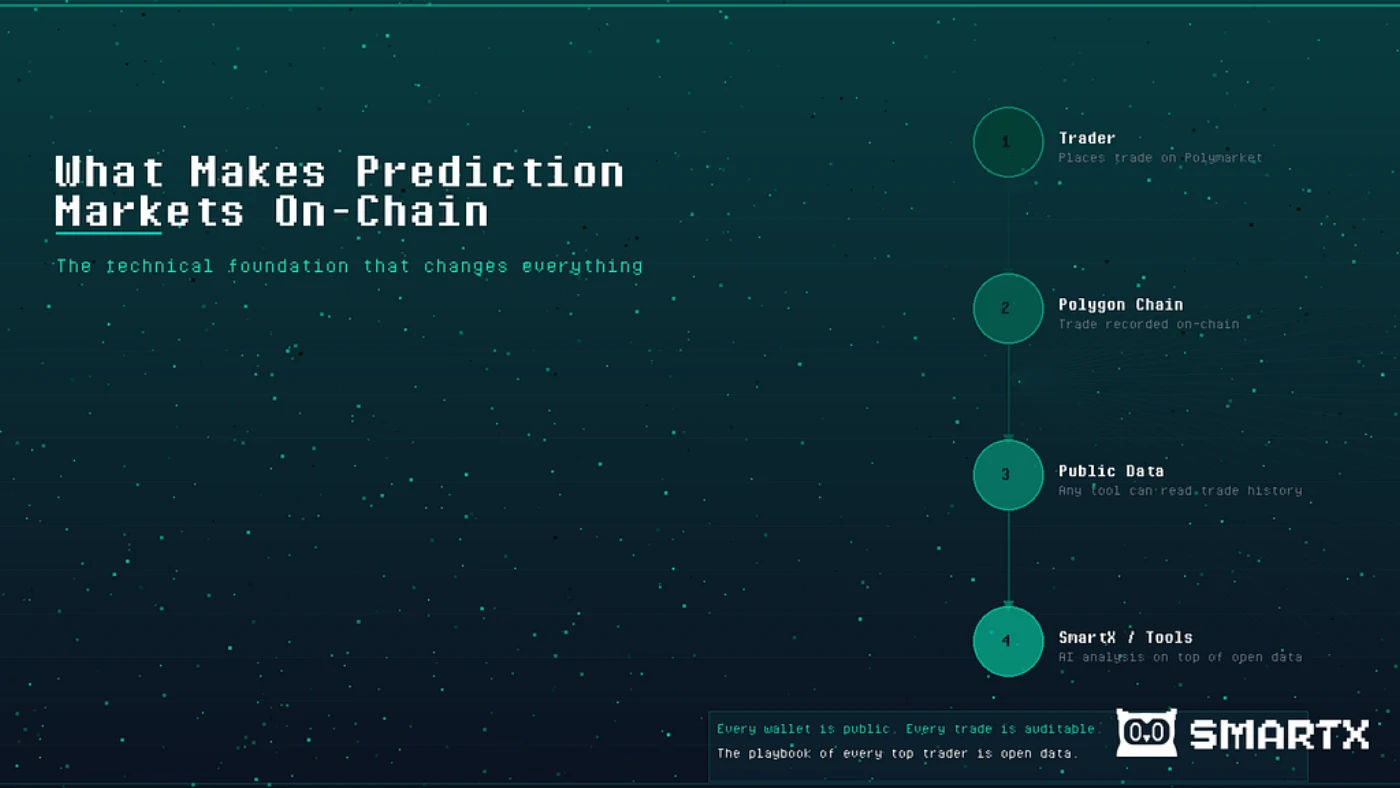
Every trade on Polymarket is recorded on the Polygon blockchain. This means that every position, every entry price, every exit, every wallet — it’s all public, permanent, and auditable. Not public in the way that a centralized platform makes data available when it feels like it. Public in the way that anyone can query the blockchain and see the complete trade history of any wallet, any time, without permission.
This is categorically different from sports betting, stock trading, or any other financial market most people interact with. Those markets operate on closed ledgers. The data is owned by the platform and shared selectively if at all. Polymarket’s data is owned by no one and available to everyone.
Why this creates an unusual information environment
In a traditional market, the only way to study successful traders is if they choose to share their results. In an on-chain prediction market, every successful trader’s history is already public. You can look up the top Polymarket wallets by return, analyze their positions, identify their categories of specialization, study their sizing patterns, and understand what a profitable prediction market strategy looks like in practice.
This transparency creates an information environment unlike anything else in speculative trading. The edge that successful traders have developed is visible and, to a meaningful degree, learnable.
Composability: why on-chain data enables better tools
Because Polymarket’s data lives on-chain, any developer can build tools that interact with it. This is how products like SmartX work: by reading on-chain trade data and building analytics layers on top of it that the base platform doesn’t provide.
In a centralized prediction market, this would require a partnership with the platform and access to proprietary data. On Polymarket, the data is already there. The ecosystem of tools that’s grown up around it — analytics dashboards, wallet tracking tools, AI terminals — exists precisely because of this open data structure.
The trust implications
An on-chain market is also trustless in a specific technical sense: the resolution and payout logic is encoded in smart contracts, not enforced by a company. When a market resolves, the payouts are distributed automatically based on contract logic, not at the discretion of a platform operator. This eliminates certain classes of counterparty risk that exist in centralized prediction markets.
What this means for serious traders
The on-chain foundation of Polymarket isn’t a technical curiosity — it’s what makes serious, systematic prediction market trading possible. The data availability, the tool ecosystem, and the trust structure all flow from the decision to build on public blockchain infrastructure.
Traders who understand this structure have access to analytical depth that simply doesn’t exist in any other trading environment of comparable scale.
SmartX is built to take full advantage of this open data structure — surfacing insights from your on-chain trade history that would otherwise require hours of manual analysis.
Start at https://app.smartx.io/?ref=hwGjVafr.
LIVE ON POLYMARKET