
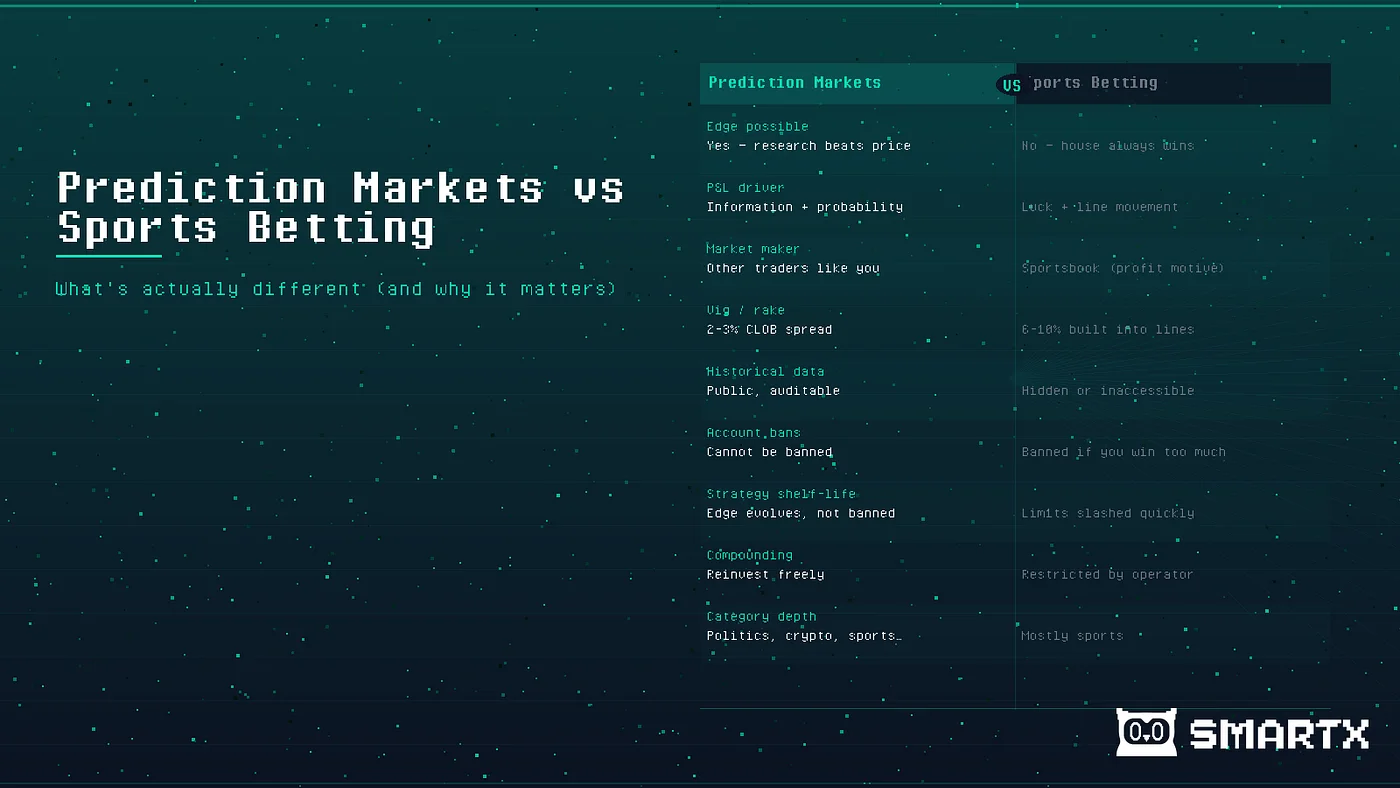
You’re trading against other traders, not a house
On a traditional sportsbook, you’re betting against the house, which sets odds and manages risk through the vig. The house’s goal is to balance action on both sides and collect the spread. Your counterparty is the sportsbook’s book balancing operation.
On Polymarket, you’re buying and selling with other participants. When you buy YES at 60%, someone is selling YES (or buying NO) at 60% with an opposite view on the outcome. You’re not betting against a house with a structural profit motive — you’re betting against other traders who also believe they have edge.
This changes the nature of the game. On a sportsbook, the main question is whether your estimate is better than the sportsbook’s line. On Polymarket, the question is whether your estimate is better than the aggregate of all other informed participants. High-profile markets attract sophisticated analysis from many sources, making them harder to beat. Niche markets with less analytical coverage can be inefficient.
Markets update in real time — and you can exit mid-event
Traditional sports betting locks you in. Once the game starts, your bet is typically set. You can’t close your position if the team you bet on goes down 14–0 in the first quarter.
Prediction markets let you exit at any time before resolution, at whatever price the market is currently offering. This cuts both ways. You can cut a losing position if your analysis changes. You can lock in profits if you bought YES at 40% and it’s now at 75% before resolution.
But it also creates a temptation that doesn’t exist in traditional betting: the ability to exit based on emotions or short-term market movements rather than your underlying analysis. Experienced prediction market traders are generally deliberate about when they exit early — they have explicit criteria for closing before resolution, rather than making that decision based on how they feel when they check the price.
The categories go well beyond sports
Sportsbooks focus almost entirely on athletic competitions. Prediction markets cover sports, politics, economics, science, crypto, and essentially any verifiable future event. This is both an opportunity and a trap.
The opportunity is category specialization: if you have genuine expertise in an area that isn’t well-covered by prediction market participants, you can find edge that sports specialists and political analysts might both miss. A crypto researcher might have better estimates on blockchain development milestones than either sports bettors or political forecasters.
The trap is category drift: treating all categories as equally approachable because they’re on the same platform. A sports bettor who wanders into political markets because they seem interesting is competing in a category where their existing edge doesn’t transfer.
Your history is visible — and so is everyone else’s
On a traditional sportsbook, your betting history is private. On Polymarket, your wallet’s entire trade history is on-chain and publicly queryable. This works in both directions.
It means sophisticated traders can analyze your patterns if they want to. More usefully, it means you can analyze anyone else’s patterns. The behavioral data that would normally only be available to the house — who bets what, at what prices, how often, in which categories — is available to everyone.
SmartX is built around this data advantage. The behavioral tagging system reads every wallet’s on-chain history and identifies what type of trader it is, what categories it wins in, and how its strategy has performed over time. A trader coming from a sports betting background who wants to understand what kinds of Polymarket participants they’re actually competing against can see that directly — not as an aggregate statistic, but wallet by wallet.
Understanding who you’re playing against is the adjustment that matters most when moving from traditional betting to prediction markets.
LIVE ON POLYMARKET