
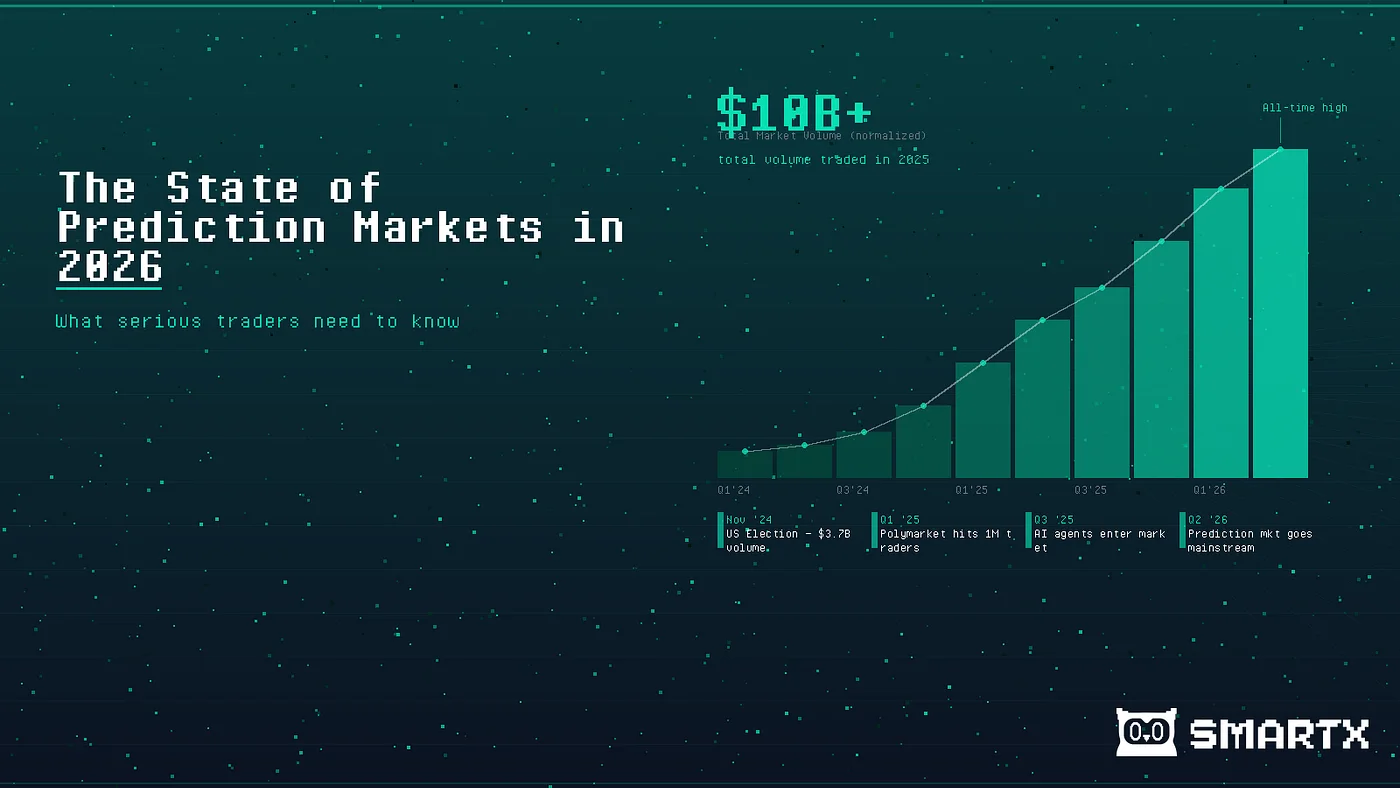
Volume has concentrated and competition has intensified
Prediction markets have spent most of their existence as a niche curiosity. Academic researchers cited them as interesting proof-of-concept for aggregating distributed information. A small community of traders treated them as a serious edge-seeking venue. Everyone else largely ignored them.
2025 and 2026 changed that. The combination of high-profile political market accuracy, significant capital inflows, and improved accessibility through crypto infrastructure pushed prediction markets into mainstream financial coverage for the first time. The result is a different competitive landscape than the one that existed two years ago — and serious traders need to understand what changed and what it means for their approach.
Polymarket’s volume has grown substantially, but the growth hasn’t been uniform across market types. Political markets — particularly US and global election markets — attracted significant attention and capital from sophisticated forecasters, hedge funds with geopolitical analysis capabilities, and professional bettors moving from traditional markets. These markets are now among the most efficiently priced prediction markets in the world.
Sports markets have seen parallel growth, with the highest-volume segments increasingly contested by automated market makers and quantitative traders who’ve built infrastructure specifically for prediction market execution. The edge that was available to careful manual sports bettors two years ago is harder to find at scale today.
Economic indicator markets, crypto-adjacent markets, and science/technology markets have grown more slowly and retain more retail participation. These categories tend to have wider spreads and less sophisticated analytical coverage — which means they’re harder to trade efficiently but potentially more inefficient in their pricing.
The infrastructure has professionalized
Two years ago, the tooling available for prediction market trading was minimal. Raw on-chain data, a basic leaderboard, and whatever custom analysis a trader could build for themselves. Today, the ecosystem includes behavioral analytics tools, smart money tracking, signal services, and terminals purpose-built for prediction market trading.
The professionalization of tooling creates a new kind of information asymmetry. Traders with access to behavioral analytics — who can see wallet-level strategy types, category-specific performance, and real-time smart money positioning — have a meaningfully different information environment than traders relying on the native Polymarket interface.
This is a structural shift. In 2023, almost all Polymarket participants had roughly the same analytical tools. In 2026, there’s a growing gap between traders who’ve built or adopted analytical infrastructure and those who haven’t.
What the most profitable strategies actually look like now
The wallets with the strongest and most consistent performance on Polymarket in 2026 share some identifiable characteristics.
Category specialization is nearly universal among consistent top performers. The idea that a skilled generalist can outperform specialists in their domains has been tested at scale now, and the data doesn’t support it. Top sports market performers are almost exclusively focused on sports. Political market leaders tend to have specific analytical frameworks for the types of events they trade.
Behavioral discipline — consistent position sizing, limited flip rates on conviction positions, clear criteria for market selection and avoidance — shows up consistently in wallets with sustainable track records as opposed to wallets that spike and then regress to mean.
Analytical infrastructure is increasingly a differentiator. The most sophisticated participants are not manually checking news and forming opinions — they’re running systematic processes, whether quantitative or structured qualitative, to generate probability estimates that they then compare against market prices.
Where retail traders still have genuine edges
The honest answer is that retail prediction market traders have fewer obvious advantages in 2026 than in 2022. The most efficient markets are genuinely efficient, and trying to beat professional forecasters in their best categories with casual analysis doesn’t work.
The edges that remain accessible:
Category niches with low sophisticated coverage. Any market category that doesn’t attract significant analytical attention from professional forecasters is potentially inefficient. If you have specialized knowledge in a category that most prediction market participants don’t focus on, that knowledge may still be genuinely valuable.
Information speed in low-profile markets. Niche markets often price in news slowly. If you have fast access to relevant information in a market category without many active participants, you can systematically capture that speed advantage.
Behavioral discipline in any market. Most retail participants still exhibit predictable biases — loss aversion, recency bias, overconfidence on obvious outcomes. Trading with genuine discipline in position sizing and exit criteria produces above-average results even without superior information.
Self-knowledge and category focus. Perhaps the most underrated edge: knowing exactly which market types you’re actually good at and concentrating there, rather than trading across categories where your base rate is average or below.
The right tool for this environment
In this environment, SmartX addresses the structural information gap directly. The behavioral tagging system identifies which wallets have demonstrated genuine edge in which categories, so you’re not trying to read signal from raw leaderboard data. The Trade Memory system builds the record you need to know your own category performance accurately. The Personalized Recommendation engine surfaces markets where your specific demonstrated strengths apply.
The prediction market landscape in 2026 is more competitive than it’s ever been. That means traders who approach it systematically — with clear records, category focus, and analytical tools — have a larger advantage over those who don’t than they did three years ago.
LIVE ON POLYMARKET