
The volume concentration isn’t obvious from the interface
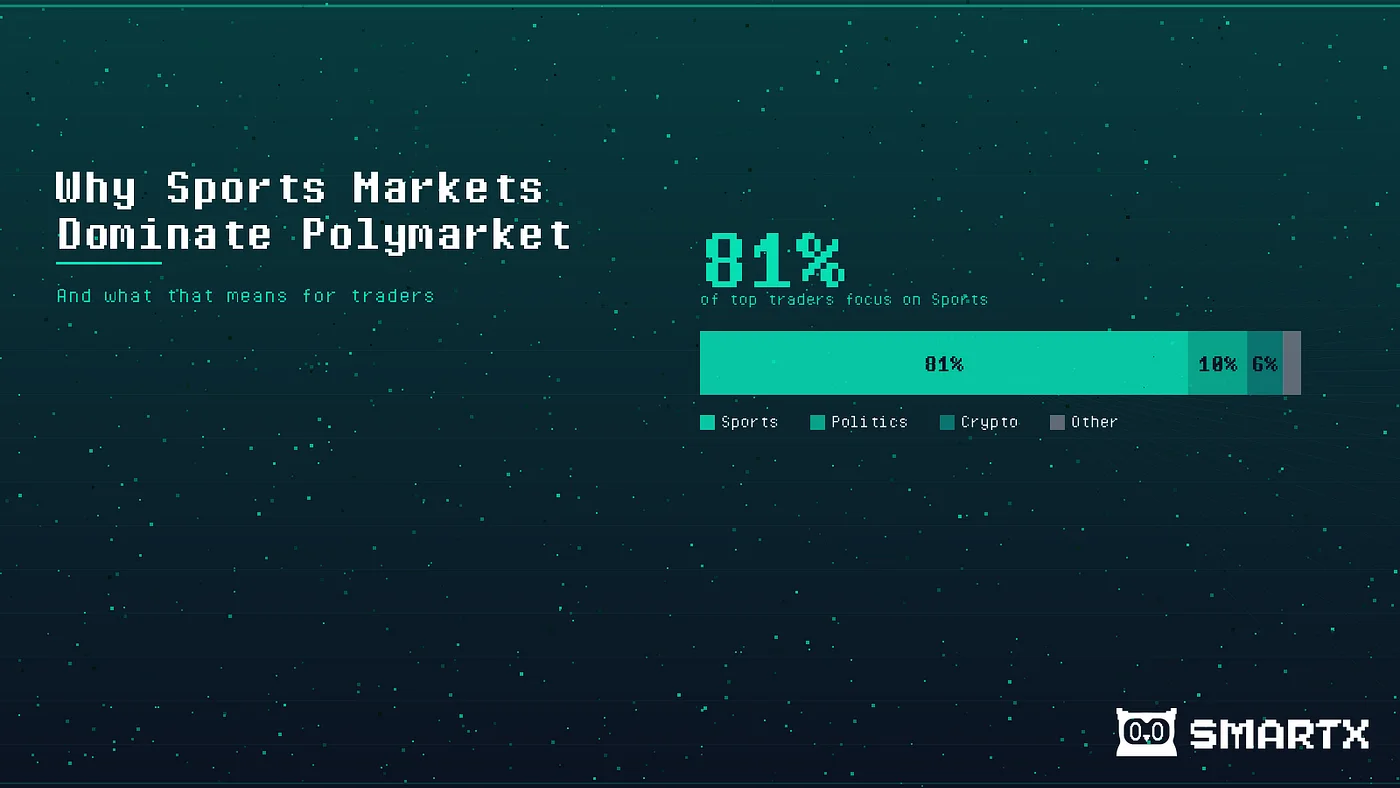
If you look at how Polymarket’s volume actually distributes across categories, one thing stands out immediately: sports markets represent a disproportionately large share of trading activity, and the most consistently profitable wallets are overwhelmingly concentrated there.
This isn’t random. And understanding why it’s true tells you something important about where edge actually exists on prediction markets — and what skills are required to find it.
Polymarket’s interface shows you markets across categories without making it especially clear how volume differs between them. But look at the on-chain data and the picture sharpens considerably. The highest-frequency profitable traders — the ones running thousands of bets per week with thin but positive win rates — are almost universally in sports. When you look at wallets that do 81% or more of their volume in sports markets, you’re often looking at the top of the performance rankings.
The political and crypto markets get more press coverage — elections and crypto prices are more culturally interesting to write about. But from a trading efficiency standpoint, sports markets have characteristics that make them uniquely useful for several types of edge.
Why sports markets attract sophisticated traders
High resolution rate with hard deadlines. Sports markets resolve on a fixed schedule, with binary outcomes (win/lose/draw) and no ambiguity about who’s right. Political markets often have interpretation debates. Crypto markets can be volatile in both directions. Sports markets close cleanly, giving traders fast feedback loops.
Large base rate libraries. Statistical records on sports performance are unusually rich compared to most other prediction market categories. Historical head-to-head records, team performance metrics, injury impact data, and even specific referee or venue effects are extensively documented. For traders who invest in building models, this data density creates real informational and analytical advantages.
Liquidity at volume. Because sports markets attract high participation, they tend to have better liquidity than niche political or economic markets. This makes large position sizing more practical without moving the market against yourself on entry or exit.
Frequent market creation. Major sports seasons generate predictable streams of markets, allowing traders to develop routines and refine their analytical processes on comparable market structures repeatedly.
What this means if you’re not primarily a sports trader
The dominance of sports in Polymarket trading activity doesn’t mean all other categories are dead money. Political markets, economic indicator markets, and crypto-adjacent markets all have active traders with genuine edges. But a few things are worth internalizing:
First, if you’re trading political markets and wondering why results feel inconsistent, part of the answer may be that these markets are structurally harder to develop repeatable edge in. The information environment is noisier, base rates are harder to calculate, and markets resolve much less frequently — meaning your feedback loop is slower.
Second, category-specific performance matters. A trader who is excellent at sports markets and mediocre at political markets should concentrate almost entirely in sports — not out of preference, but because the data says that’s where their edge is.
Third, the skills required for different categories don’t transfer cleanly. Sports edge comes from quantitative modeling, injury news processing, and understanding team dynamics. Political edge comes from probability calibration, polling interpretation, and base rate reasoning. If you want to develop edge in a new category, treat it as learning a new skill set, not as applying your existing one to different content.
Tracking sports-focused smart money
The behavioral patterns of consistently profitable sports traders on Polymarket are distinct from other categories. High-frequency sports traders tend to have: tighter bet sizing, faster position turnover, much higher bet counts per week, and win rates that hover near 50% with a slight positive edge that compounds over volume.
Conviction sports traders have the opposite profile: fewer bets, larger sizes, lower turnover, and win rates that sometimes exceed 65% in markets they specialize in.
SmartX tags wallets by their behavioral profile and category focus. If sports markets are where you operate, the relevant filter isn’t “who made the most money overall” — it’s “which wallets with proven sports track records are currently positioning, and where.” That information exists in the on-chain data. The question is whether you have a tool that surfaces it at the right time.
The practical takeaway
If you haven’t analyzed your own Polymarket performance by category, do it. Your results in sports markets and your results in political markets are likely not the same, and the difference is telling you where your time and capital should be concentrated.
If you haven’t looked at which sports-focused wallets on Polymarket have genuinely consistent track records — not just recent lucky streaks — that’s a useful research project. The behavioral data is public. The traders worth watching are identifiable. The question is whether you’re reading the right data.
LIVE ON POLYMARKET