
Loss aversion shows up differently on binary markets
Prediction markets have an advantage over most other forms of trading when it comes to studying psychology: they resolve cleanly, with hard deadlines and unambiguous outcomes. There’s no “I was right but the market didn’t reflect it” — the market resolves, you were either correct or you weren’t, and your bankroll changes accordingly.
This clarity is valuable. But it also exposes psychological vulnerabilities in ways that can be expensive if you don’t recognize them. Losses on prediction markets feel different from losses on traditional financial instruments because there’s no ambiguity — you bet the wrong way and lost, period.
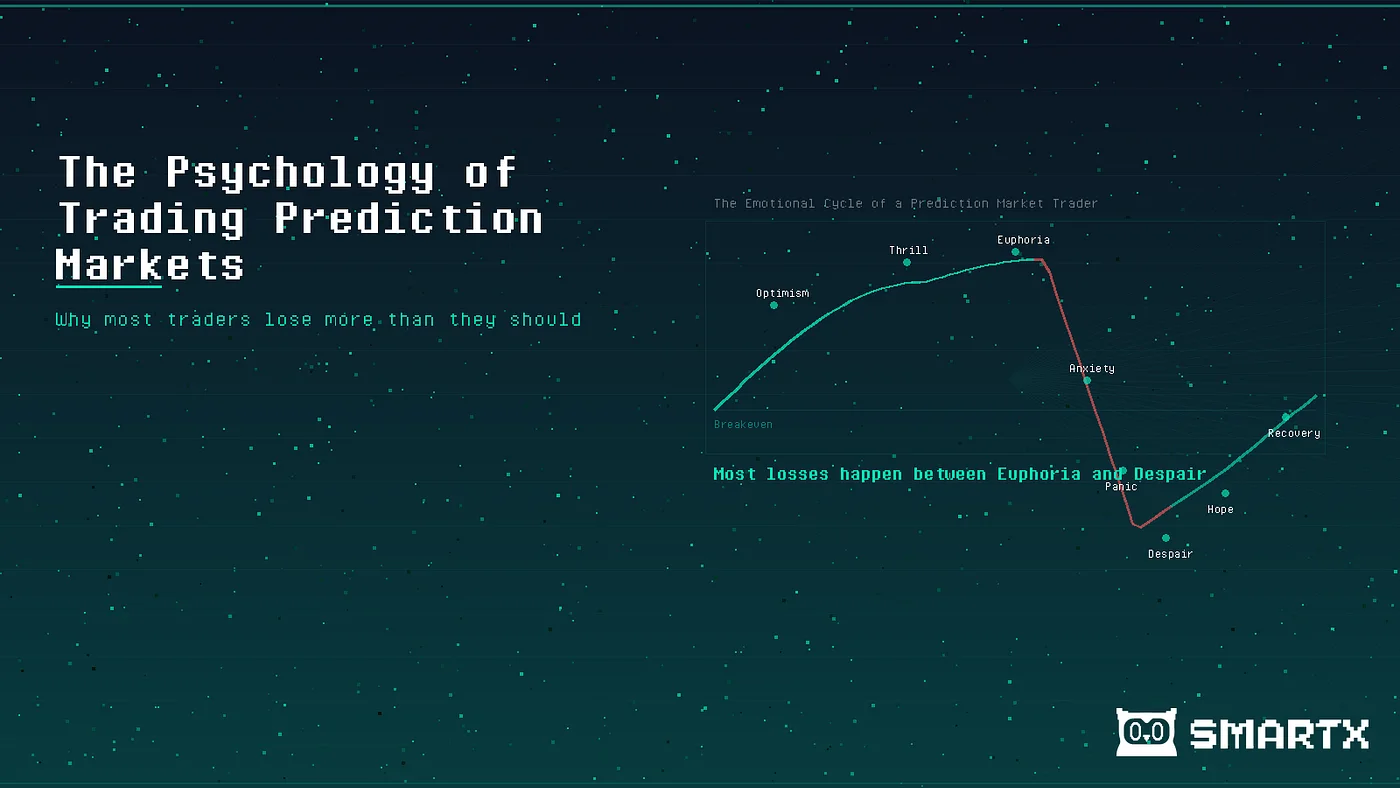
Standard behavioral finance research shows that losses feel roughly twice as painful as equivalent gains feel good. On prediction markets, this manifests in a specific pattern: traders close losing positions early to avoid the psychological discomfort of watching them go to zero, even when holding would be the correct decision based on updated probabilities.
The correct question when a position moves against you isn’t “how much have I lost so far?” It’s “given the current market price and my current probability estimate, is this still a positive expected value bet?” If YES is now trading at 30% and you originally bought at 50%, your decision to hold or exit should depend on your current estimated probability — not on the fact that you paid 50%.
Selling a position because it’s down locks in a loss that might have been recoverable. More importantly, it makes the decision based on your entry price rather than the current situation, which is exactly the wrong input.
Recency bias causes traders to over-update on recent outcomes
After a winning run, traders tend to increase bet sizes and loosen entry standards. After a losing run, they tighten up, reduce size, or stop trading entirely — often right before their edge starts working again.
This is recency bias: weighting recent outcomes more heavily than the underlying probabilities warrant. If you have genuine edge that wins 58% of the time and you run a losing stretch of 7 out of 10, the probability that the next bet wins hasn’t changed — it’s still roughly 58%. But psychologically, it feels like something has gone wrong and the edge has disappeared.
The antidote is records. If you have a clear historical win rate across a sufficient sample in specific market categories, a losing streak doesn’t change what the data says. The question becomes whether the streak is within normal variance (usually yes) or whether something about your approach has structurally changed (occasionally).
Confirmation bias is particularly dangerous in research
Prediction markets require forming a view on an outcome and betting on it. This creates a natural tendency to seek information that confirms the position you’ve already taken or are considering, and to dismiss information that contradicts it.
This is confirmation bias, and it’s especially common when a trader has an existing opinion about a topic before looking at the market. A trader who believes Team A will win before checking the Polymarket price is likely to find their research confirming that belief — not because the evidence points that way, but because they’re filtering evidence through a prior commitment.
The structural solution is to form your probability estimate before looking at what you want to bet on. Assess the situation, set a number, then check the market price. If the market is significantly more bullish or bearish than your estimate, that’s useful information — either the market is wrong, or there’s information you’ve missed. Both are worth investigating rather than ignoring.
The size trap: betting too big on “obvious” outcomes
The most common bankroll-destroying pattern in prediction market trading is sizing up dramatically on outcomes that feel obvious. When something seems clearly inevitable, traders bet a large percentage of their capital on it, reasoning that the probability is so high the risk is minimal.
This ignores two things. First, prediction markets on obvious outcomes usually price them close to their true probability — if everyone thinks it’s 90%, the price is usually near 90%. The expected return on a 90% bet at 90% is roughly zero after fees. Second, even “obvious” outcomes resolve wrong with meaningful frequency. A bet that feels like 95% to a trader who’s gotten excited about an outcome is often closer to 80% in reality, and a 20% chance of a total loss is not a small risk.
Using data to protect yourself from yourself
SmartX captures the context of trading decisions through Trade Memory — not to tell you what to do, but to give you the record you need to identify your own psychological patterns. Do you consistently exit positions early when they move against you? Do your win rates drop after a losing streak? Do you size up on positions that feel obvious and underperform on those compared to your more tentative bets?
These patterns are identifiable from data. Identifying them is the first step to managing them.
Prediction market psychology doesn’t require reading a textbook. It requires honest record-keeping and the willingness to look at what the data says about your own decision patterns — not just your outcomes.
LIVE ON POLYMARKET