
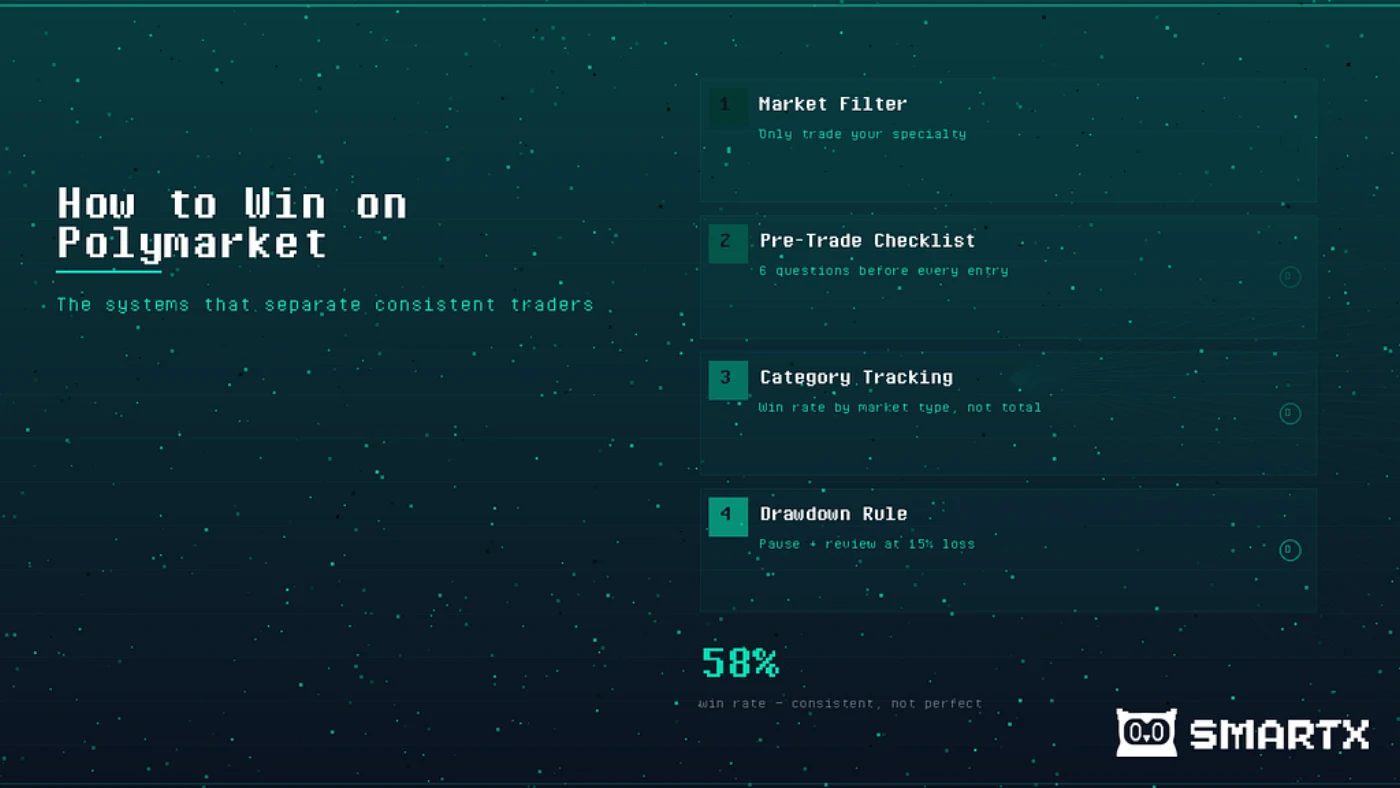
Why consistent winning requires structure
“How do I win on Polymarket?” is the most common question from new prediction market traders. The honest answer is that winning consistently requires something most people don’t expect: structure.
Not prediction skill. Not superior intelligence. Not access to proprietary data. Structure — a set of systems that force you to be disciplined about where you trade, how much you risk, and how you evaluate your performance over time.
The traders who show up consistently on Polymarket leaderboards aren’t necessarily smarter than everyone else. They’ve built better systems.
System 1: A market filter
The first thing consistent Polymarket winners have is a filter for which markets they’ll consider trading at all. This filter is usually narrow. It might be: only NBA games, only Fed meeting outcomes, only soccer matches in the top five European leagues.
If you don’t have a filter, you’re implicitly saying “I can have an edge in any market.” That’s almost certainly not true. The filter exists to protect you from the large number of markets where you’re guessing rather than edge-trading.
System 2: A pre-trade checklist
Before entering any position, run through a short checklist: What’s the current market probability? What’s my estimated probability, and why is it different? What information or analysis supports my estimate? What’s my entry size? What’s my exit condition (profit target and loss limit)? Does this market have sufficient liquidity at my intended size?
If you can’t answer these questions, you’re not ready to trade the market. The checklist takes two minutes and eliminates a large class of trades that lose money.
System 3: Categorized performance tracking
Winning on Polymarket isn’t about winning all your trades. It’s about winning more in the categories where you have edge and losing less in the ones where you don’t. The only way to know the difference is to track your results by category.
Most traders track total P&L. The better metric is win rate and ROI broken down by market category. You might find that your sports markets return 18% on capital deployed while your political markets return -7%. That’s not a signal to fix your political market analysis — it’s a signal to stop trading political markets.
System 4: A drawdown rule
Every consistent Polymarket trader has a drawdown rule: a maximum loss percentage that triggers a mandatory pause and review. Common versions are 10%, 15%, or 20% of account equity.
When you hit your drawdown limit, you stop trading for at least a week and review every losing trade in detail. The review isn’t about beating yourself up — it’s about identifying whether the losses were due to bad process or bad variance. One of these needs to change. The other doesn’t.
What winning looks like in practice
A consistent Polymarket winner over a 12-month period might have a 58% win rate in their specialty category, an average ROI of 20–25% on capital deployed, and a maximum drawdown of 15–18%. They’re not batting 1.000. They’re not making 200%. They’re running a repeatable process that generates positive expected value.
SmartX helps traders build and track exactly this kind of system — giving you a clear view of your performance by category, your calibration, and where your edge actually lives in your trading history.
Start building your system at app.smartx.io.
LIVE ON POLYMARKET