
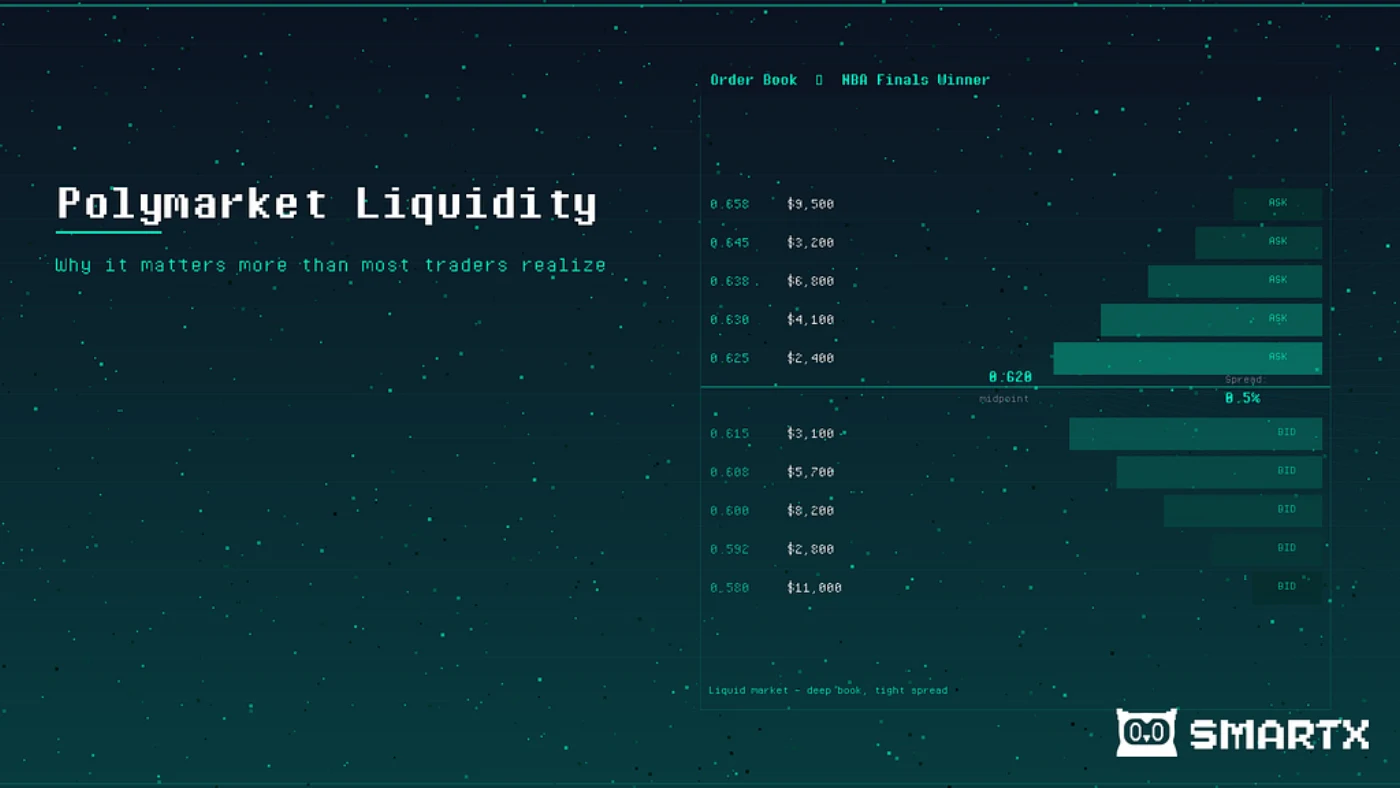
Liquidity turns edge into profit
New Polymarket traders pay a lot of attention to probability. They spend time researching outcomes, forming opinions, and deciding which way they think a market will resolve. What they don’t spend enough time on is liquidity — and it’s often why they underperform even when their analysis is correct.
Liquidity is the practical constraint that determines whether your edge translates into actual profit. Understanding it is non-optional for serious Polymarket trading.
What liquidity means on Polymarket
Polymarket operates as a central limit order book (CLOB). When you buy YES shares, you’re buying them from a seller on the other side of the trade. The difference between the price you pay and the midpoint of the market is the spread — the implicit cost of entering the trade.
In a liquid market, the spread might be 0.5–1%. In an illiquid market, it might be 3–5% or wider. This matters enormously for your net returns. If you’re entering and exiting a position with a 3% total spread, you need your edge to exceed 3% before you’ve made a single cent. Most edges aren’t large enough to absorb that cost repeatedly.
How to evaluate liquidity before trading
Before entering any Polymarket position, check: Order book depth — how many shares are available within 1–2% of the current midpoint? Bid-ask spread at your intended trade size. Historical volume — has this market been actively traded? Time to resolution — markets close to resolution are often more liquid.
The size discipline problem
One mistake that liquidity-aware traders avoid is deploying too much capital into a single illiquid market. If a market only has $10K of depth at reasonable prices, entering a $5K position is going to move the price meaningfully and cost you in spread. The right trade size in an illiquid market is often much smaller than your conviction would suggest.
This is where many traders give up performance: they find a good edge, enter too large in an illiquid market, pay a wide spread, and then find the market difficult to exit later. The edge was real — the position sizing relative to liquidity killed the return.
When to skip a market entirely
Some Polymarket markets simply don’t have enough liquidity to be worth trading for anyone beyond very small position sizes. Signs that a market should be skipped: total volume under $50K, bid-ask spread consistently above 4%, last trade more than several hours ago, fewer than three active prices in the book.
Trading a compelling but illiquid market is almost always worse than waiting for a liquid market where your edge is slightly lower. The execution cost difference is too large to ignore.
Understanding liquidity and building it into your trade selection process is one of the highest-value improvements a mid-level Polymarket trader can make.
SmartX surfaces liquidity data alongside recommendation signals so you can see not just where your edge is, but whether the market can actually absorb your trade at a reasonable cost.
Explore it at https://app.smartx.io/?ref=hwGjVafr.
LIVE ON POLYMARKET