
Type 1: Informational edge
“Edge” is one of the most used and least defined terms in prediction market trading. Everyone says they’re looking for it. Most people can’t define it precisely. And the ambiguity matters, because what you think edge means shapes everything about how you approach markets.
In most online discussions, “edge” means roughly “better information.” The implied strategy is: find a piece of news, a data source, or an insight before the market prices it in, and bet on it. This works when it works, but it describes only one type of edge — and it’s often the hardest type to have sustainably.
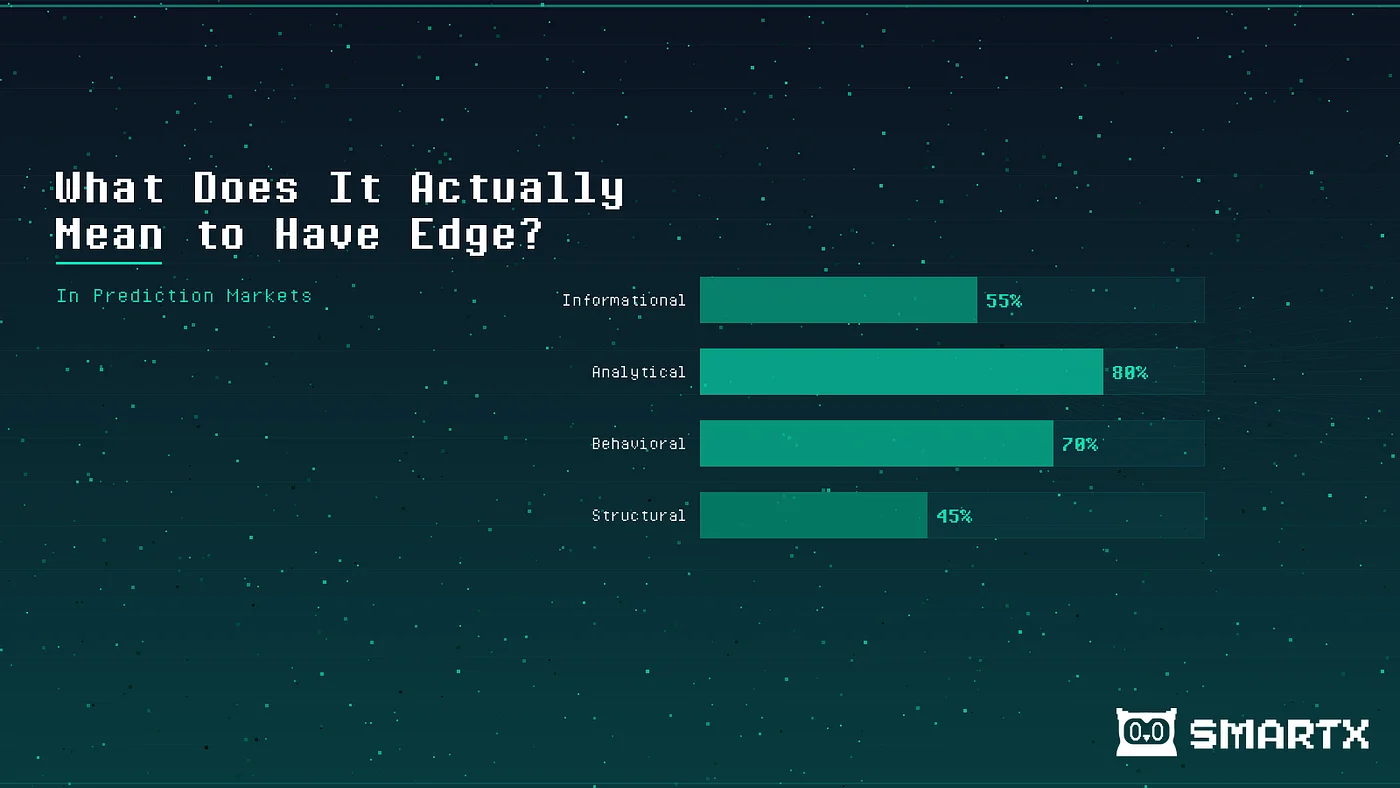
There are at least four distinct types of edge in prediction markets. Understanding which kind you actually have, if any, is the prerequisite for any strategy worth running.
Informational edge means you have access to or have processed relevant information that the market hasn’t fully incorporated yet. This is the type most people think of first.
It’s real, but harder to maintain than most traders assume. Polymarket markets in high-profile categories (presidential elections, major sporting events, crypto prices) are highly efficient — thousands of informed participants are actively updating prices based on available information. Finding genuine informational edge in these markets requires something specific: a source, an analytical process, or a data stream that the average participant doesn’t have.
In lower-profile markets with thin liquidity, informational edge is more accessible because fewer people are competing to find it. The tradeoff is that these markets are often small enough that the total extractable value is limited.
Type 2: Analytical edge
Analytical edge means you’re better at converting publicly available information into accurate probability estimates than the market’s current price reflects.
This is distinct from informational edge: you have the same data as everyone else, but your mental model produces more calibrated estimates. This is the form of edge that’s most teachable and most likely to improve with practice. Historical base rates, proper Bayesian updating, understanding how to weight different types of evidence — these are learnable skills that translate into better probability estimates.
Research consistently shows that even experienced forecasters tend to be overconfident on difficult questions and underconfident on straightforward ones. Calibration — being right as often as your confidence level implies — is a genuinely learnable and durable edge.
Type 3: Behavioral edge
Behavioral edge comes from trading better than other participants psychologically and structurally. This includes: not chasing losses after a bad session, not over-betting when on a winning streak, maintaining consistent position sizing based on conviction rather than emotion, and knowing when to sit out markets where you have no edge.
This type of edge is surprisingly common among Polymarket’s consistent winners. Many of them don’t have exceptional informational advantages — they simply have better decision-making discipline than average participants. They size bets appropriately, don’t deviate from their strategy under pressure, and pass on markets where they’re uncertain.
Behavioral edge degrades when traders don’t track their decisions systematically. Without a record of what they did and why, the feedback loop is weak — they lose the signal about when their discipline is breaking down.
Type 4: Structural edge
Structural edge means the mechanics of how you trade produce systematically better outcomes, regardless of the individual trade’s informational or analytical merit.
The clearest example is market making: placing large numbers of bets near the bid-ask spread to earn the spread repeatedly, regardless of which side wins. At sufficient volume, a 50.3% win rate produces consistent positive returns because the structural advantage compounds. This is not a strategy accessible to manual traders, but it illustrates the concept.
For non-automated traders, structural edge includes things like: consistent position sizing that lets the mathematical edge play out over many bets without risk of ruin, timing advantages (acting before markets correct on known information releases), and category focus that lets you operate in markets where your base rates are meaningfully above average.
How to find out which type of edge you actually have
Most traders assume they have informational edge because they read news and follow relevant social accounts. Some do, but fewer than think they do. A cleaner diagnostic is to look at your own trade history by category and by market type.
If your win rate is above the implied probability of your bets in a specific category, across a meaningful sample, you have some form of edge in that category. If it’s below or at the implied probability, you don’t — and the absence of edge is also useful information.
This is the exact analysis SmartX runs automatically from your trading history. The Trade Memory system captures the context of every trade, and the analytical layer identifies where your results consistently beat market-implied probabilities and where they don’t. This lets you concentrate capital where the data shows real edge and avoid categories where your results look like chance.
Understanding which type of edge you actually have — and having the data to back up that understanding — is what separates disciplined prediction market trading from sophisticated-sounding gambling.
LIVE ON POLYMARKET